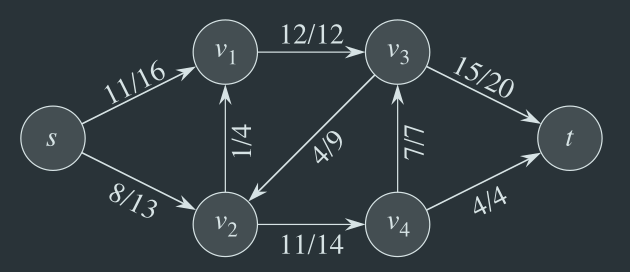
A flow network G = (V,E) is a directed graph with the following properties:
- Each edge
(u,v) \in Ehas a nonnegative capacityc(u,v) \geq 0. - If
Econtains an edge(u,v)then there is no edge(v,u)in the reverse direction. - No self-loops.
- If
(u,v) \notin E) then we define =c(u,v) = 0. - Two distinguished vertices: a source
sand a sinkt, which has a path for which each other vertex lies.
The point of such a network is to model flow from s to t. A such flow in G is a
real-valued function f : V \times V \rightarrow R that satisfies the following two properties:
- Capacity constraint: For all
u,v \in V, we require0 \leq f(u,v) \leq c(u,v). - Flow conservation: For all
u \in V - {s,t}, we require
The value |f| of a flow f is defined as
Alterations
Anti-parallel edges
If we have an edge that violates the property that if (v_1, v_2) \in E then (v_2, v_1) \notin E then we call the two edges (v_1, v_2) and (v_2, v1) antiparallel. We
can rewrite such edges to attain an equivalent network that conforms to our
properties of a flow network. This is done by choosing one of the antiparallel
edges, in this case (v_1, v_2), and splitting it by adding a new vertex v' and replacing
edge (v_1, v_2) with the pair of edges (v_1, v') and (v', v2). Finally we set
the capacities of the new edges equal to the replaced edge c(v_1, v_2) = c(v_1, v') = (v', v2).
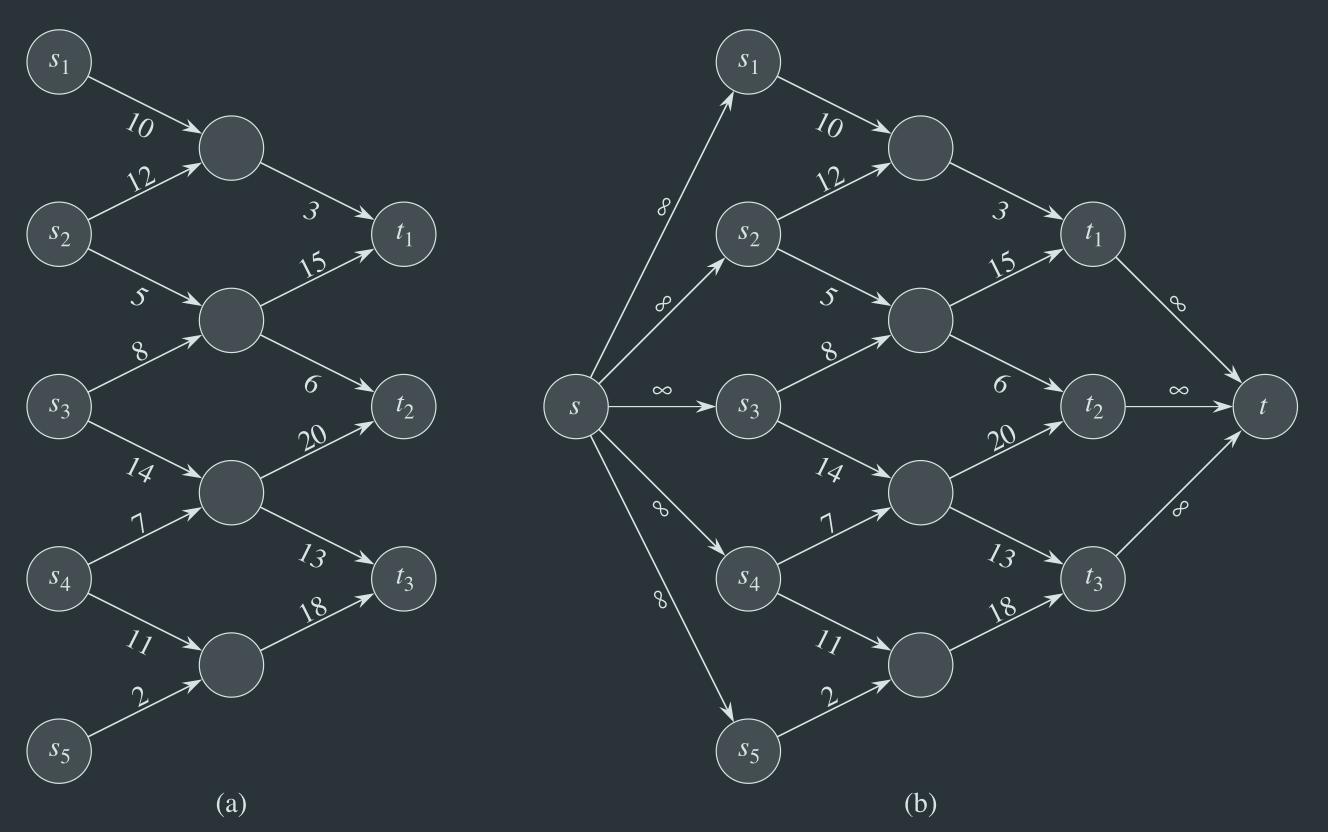
Multiple sources and sinks
We can convert networks with multiple sources {s_1, s_2, ..., s_m} and sinks
{t_1, t_2, ..., t_n} to a flow network only a single source and sink.
This is done by adding a supersource s and a directed edge (s, s_i) with
capacity c(s, s_i) = \infty for each i = 1,2,...,m. We also add a supersink t and a
directed edge (t_i, t) with capacity c(t_i, t) = \infty for each i = 1,2,...,n. An
illustration can be seen in examples.
Examples
Flow network with notated f(u,v)/c(u,v)
Altering a multiple-source multiple-sink network (a) to an ordinary flow network (b)