Minimalist Transport Layer Protocol.
Features
- Finer application-level control over what data is sent: as soon as an application process passes data to UDP, it will package the data into a segment and pass it to the network layer straight away.
- No connection establishment: UDP does not use a handshake preliminary like TCP does. Thus UDP does not cause any delay by establishing a connection, making it ideal for services like Domain Name System (DNS).
- No connection state: UDP does not use receiver- or send buffers or track parameters for Congestion or acknowledgement numbers as TCP does.
- Small packet header overhead: UDP has a small header overhead of 6 bytes per segment, which is smaller than TCP which has 20 bytes.
- Error detection: UDP checks for bit errors by using a checksum field described below in Segment Structure. Many Link Layer Protocols also provide error detection, but only on a link-by-link basis and not on an end-to-end basis as UDP.
Segment
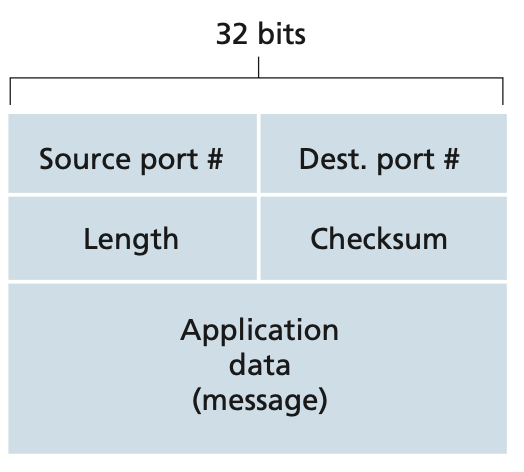
The header of an UDP segment consists of: