A model of organising the set of Protocols that govern communication over the internet.
It is organised so each layer is responsible for a specific aspect of network communication according to Network Layer Encapsulation, these layers can be seen in the image below.
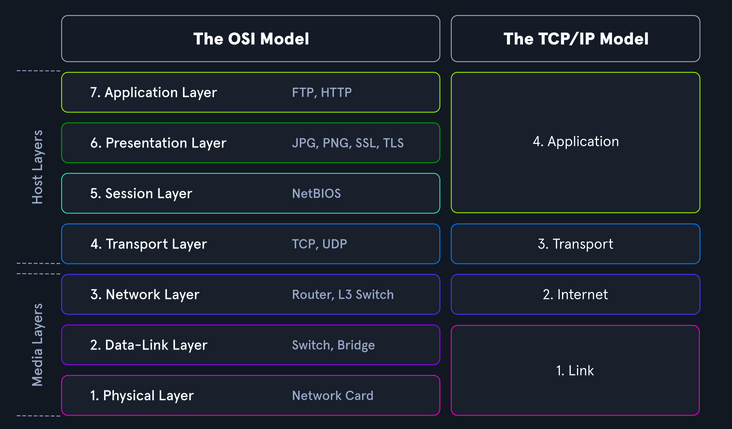
This organisation of layers is different that the IP Protocol Stack, in the way that some layers in that model is a super set layers in this model as seen in the above image.
Layers
7. Application
Provides network services directly to end-user applications.
Protocols
- HyperText Transfer Protocol (HTTP)
- File Transfer Protocol (FTP)
- Simple Mail Transfer Protocol (SMTP)
- Domain Name System (DNS)
6. Presentation
Handles translation between the application layer and the network format. It is responsible for data representation, ensuring that data sent by the application is readable by the receiving application.
This includes encryption and decryption, data compression, and converting data formats.
5. Session
Responsible for establishing, managing, and terminating communication sessions between applications on different hosts.
Key features are:
Dialogue control: determining how data flows between two systems (Simplex, Half Duplex, or Full Duplex).Session management: handle the setup, maintenance, and tear-down of connections.Synchronisation: insert checkpoints into the data stream to allow for recovery in case of a network failure, preventing the need to restart the entire transfer.Authentication and authorisation: manage the security parameters required to maintain an active session.
4. Transport
Used for end-to-end control of the transferred data. The Transport Layer can detect and avoid congestion situations and segment data streams.
Protocols
3. Network
Handles Packet forwarding, including Routing. It is responsible for Address Assignment and and ensuring that data reach the correct destination.
Protocols
2. Data Link
Handles transmissions on the respective medium between Nodes.
For this purpose, the bit-streams from layer 1 are divided into frames. It ensures that the data frames are transmitted with proper synchronisation, error detection, and correction.
Packet Switches operate at this layer.
Protocols
1. Physical
Manages how the transmission takes place on wired or wireless transmission lines.